When parents enroll their children in piano lessons, they're usually thinking about music. But the benefits extend far beyond learning to play songs. Research consistently shows that piano study reshapes the developing brain in ways that impact academic performance, emotional health, and life skills.
As a piano teacher with over 9 years of experience working with children, I've witnessed these transformations firsthand. Here are seven benefits that often surprise parents — backed by science and real stories from families at Maria Piano Studio.
1 Enhanced Focus and Concentration
Learning piano requires sustained attention: reading notes, coordinating both hands, listening to rhythm, and tracking your place in the music — all simultaneously. This multi-tasking workout strengthens the brain's ability to focus.
A 2019 study from the University of Vermont found that children who received music training showed faster development in areas of the brain responsible for attention and impulse control.
"I've noticed such a difference in my daughter's ability to concentrate since she started piano. Her teachers at school have commented on it too — she can focus on tasks much longer now without getting distracted."
— Emma R., mother of 4-year-old Lily, Microsoft2 Stronger Math and Spatial Reasoning Skills
Music is mathematical at its core. Rhythm involves fractions (quarter notes, half notes, eighth notes). Reading music requires understanding patterns and proportional relationships. Playing scales introduces concepts of intervals and sequences.
Research from Stanford University demonstrated that students with music training showed significantly higher scores in mathematical reasoning, particularly in areas involving fractions, proportions, and spatial-temporal reasoning.
What we see at Maria Piano Studio: Students who learn to read music and understand rhythm often tell us that fractions suddenly "make sense" in math class. The connection between musical and mathematical thinking is powerful.
3 Improved Memory
Playing piano exercises multiple types of memory simultaneously:
- Working memory — holding the next few notes in mind while playing
- Long-term memory — memorizing pieces for performance
- Muscle memory — training fingers to find keys automatically
- Auditory memory — remembering how pieces should sound
This comprehensive memory workout translates to better recall in academic subjects. A study in the Journal of Neuroscience found that children with music training had better verbal memory and faster information processing than their peers.
4 Emotional Intelligence and Self-Expression
Music is a language for emotions that words can't capture. Learning to play expressively — to make a phrase sound sad or joyful, calm or excited — develops emotional awareness and vocabulary.
At Maria Piano Studio, we don't just teach notes. We ask students: "How does this piece make you feel? How can you show that feeling through your playing?" This process builds emotional intelligence that serves children in all areas of life.
"My son had trouble expressing his feelings verbally. Piano has given him an outlet. When he's had a hard day, he'll go to the piano and play. It's become his way of processing emotions — and he's become more open about talking about feelings too."
— Parent of 8-year-old student5 Discipline and Patience
In a world of instant gratification, piano teaches children that meaningful achievements require sustained effort. You can't master a piece in a day. Progress comes from consistent daily practice, working through difficult sections, and embracing the journey.
This lesson in delayed gratification — what psychologists call "grit" — is one of the strongest predictors of success in school, careers, and life.
6 Confidence and Stage Presence
Performing — whether at a formal recital or simply playing for family — builds courage. Children learn to manage nervousness, recover from mistakes gracefully, and present themselves with poise.
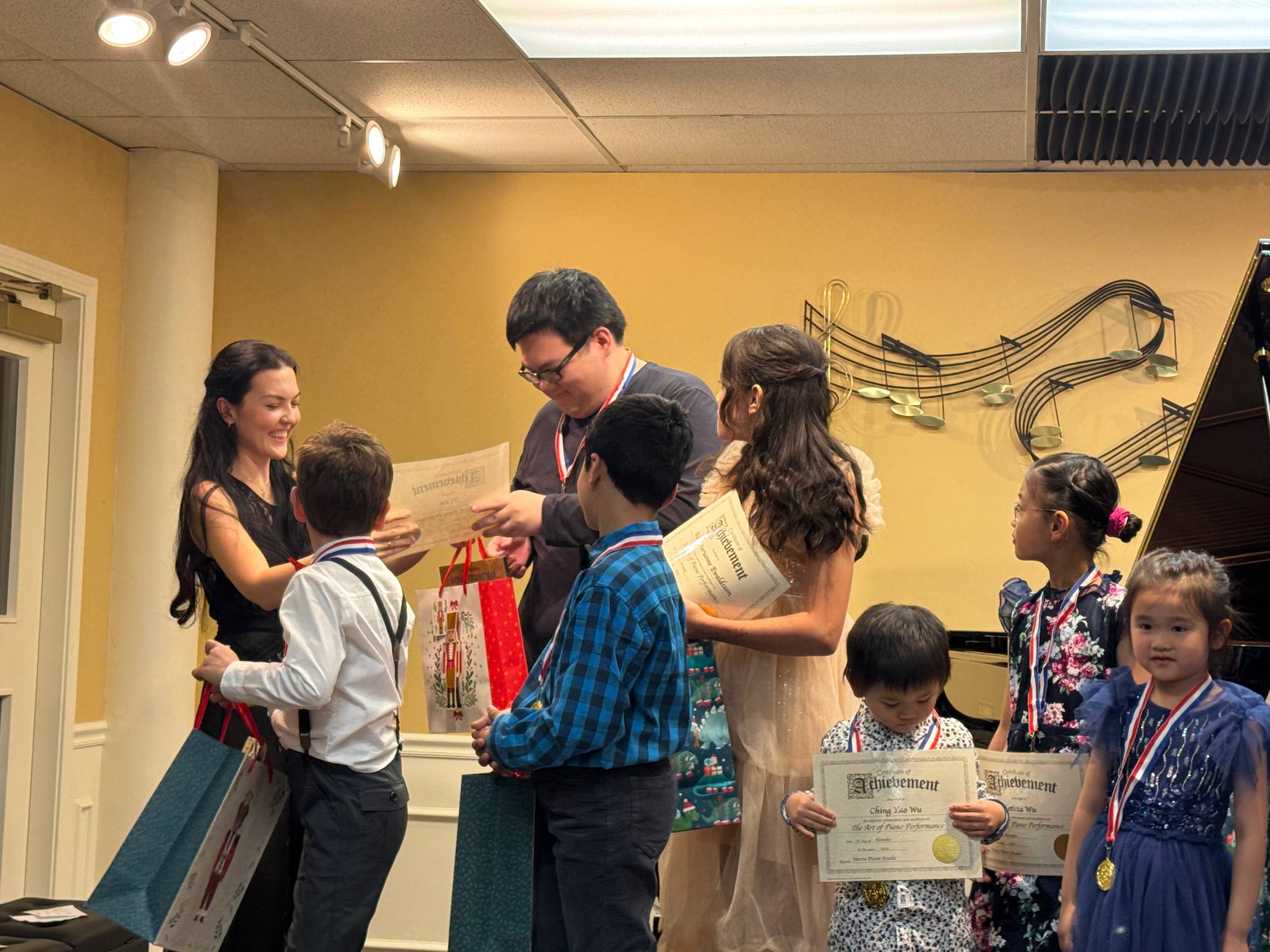
At Maria Piano Studio, we host regular recitals where students of all levels perform. Many parents tell us these experiences transformed their child's confidence in public speaking and presentations at school.
"Before piano, my daughter would freeze up during class presentations. After her first recital — even though she was nervous — she realized she could do hard things. Now she volunteers to present first. That confidence came directly from performing piano."
— Parent of 10-year-old student7 A Lifelong Source of Joy
Perhaps the most important benefit isn't measurable at all. Piano gives children a gift that lasts a lifetime — the ability to sit down and create beautiful music, to express themselves, to find comfort and joy in playing.
Students who learn piano properly — not just memorizing songs, but truly understanding music — carry this skill forever. They can pick up a songbook decades later and play. They can learn new pieces independently. They have a companion for life's celebrations and challenges.
Our philosophy: At Maria Piano Studio, we don't just teach children to play songs. We teach them to be musicians — to read, understand, and love music in a way that stays with them forever.
Why Piano Specifically?
All musical instruments offer benefits, but piano has unique advantages for children:
- Visual layout — Notes progress logically from left to right, low to high, making music theory intuitive to understand
- Immediate sound — Unlike wind or string instruments, pressing a key produces a beautiful tone immediately (no squeaking learning curve)
- Both hands, both brain hemispheres — Playing with two hands independently stimulates cross-brain development like no other instrument
- Complete harmony — Piano can play melody, harmony, and bass simultaneously, teaching children complete musical understanding
- Foundation for all music — Piano skills transfer easily to other instruments and music theory
The Right Start Matters
These benefits don't come automatically from just any piano lessons. The teaching approach matters enormously. At Maria Piano Studio, we use methods rooted in the classical Russian piano school combined with modern cognitive research to ensure students develop:
- Strong sight-reading skills (not just memorization)
- Solid technique that prevents injury and enables expression
- Deep understanding of music theory and structure
- Genuine love for playing that sustains long-term practice
The goal isn't just to create pianists — it's to develop confident, creative, focused thinkers who happen to play beautiful music.
Interested in getting started? Learn more about our piano lessons for kids in Bellevue or read our guide: What's the Best Age to Start Piano Lessons?